How to Subscribe to an ICS Calendar in Google Calendar
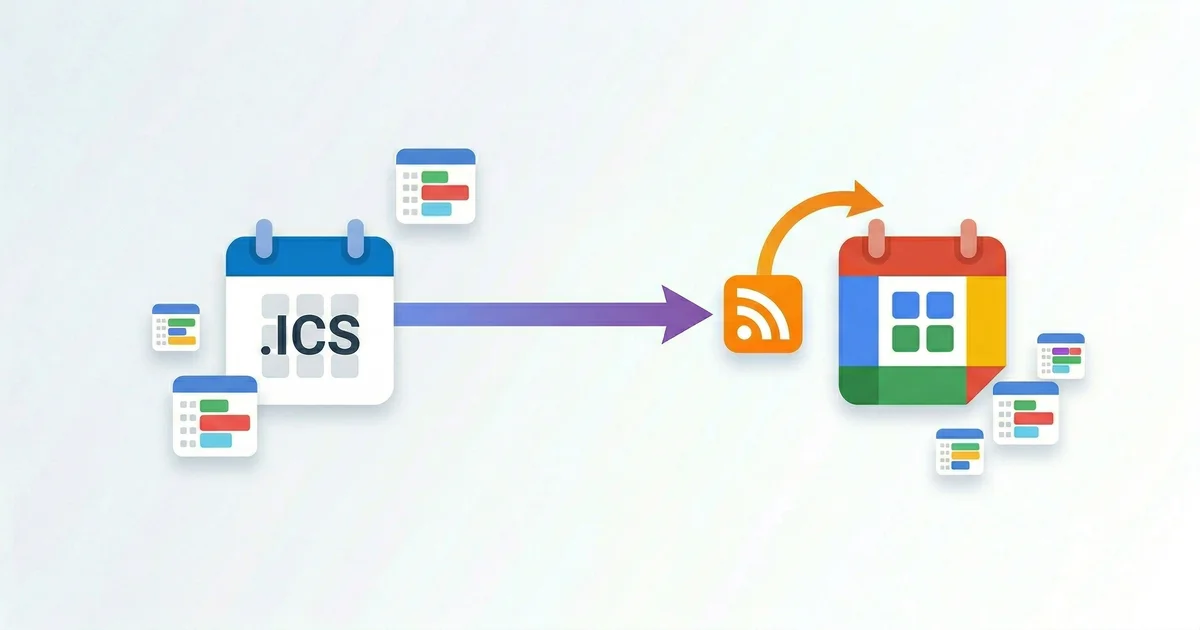
If someone sends you a calendar link (ICS or webcal URL), you can add it to Google Calendar without creating a new account. This guide shows you how to subscribe to external calendars in Google Calendar and when it makes sense.
What is an ICS/webcal URL?
ICS (iCalendar) is a standard file format for calendar events. A webcal URL (or https:// URL) points to a calendar feed that your calendar app can read and display automatically.
Key points about ICS subscriptions:
- Read-only — you can view events but can’t edit them from the subscribed calendar. Trying to edit a subscribed event will fail
- One-way — events flow from the source calendar to yours, not the other way. Changes in your calendar don’t go back to the source
- Lightweight — minimal setup, no account linking or OAuth required. Just a URL
- Slow updates — typically refreshes every 12–24 hours depending on the provider. Some sources update faster (every 6–12 hours), others slower (24+ hours)
- No duplicate detection — if the same event exists in two different calendars, ICS subscriptions don’t prevent duplicates. You’ll see the event twice
Common sources of ICS URLs:
Calendar services:
- Google Calendar shared/published calendars (secret address)
- Outlook published calendars
- iCloud public calendars
Travel and bookings:
- Airbnb listing calendars (booking availability—shows when your rental is booked)
- Vrbo and other vacation rental sites
- Hotel availability calendars
- Flight schedules (some airlines publish ICS feeds)
Sports and entertainment:
- Sports team schedules (NFL, NBA, MLB, Premier League, etc.)
- Conference and tournament schedules
- Concert and event calendars
- College sports schedules
Public information:
- Holiday calendars (public holidays by country/region)
- Lunar calendar (phases of the moon)
- Religious holidays and observances
- School and academic calendars
- Government observance calendars (federal holidays, etc.)
Team and work:
- Shared team calendars (published by companies or groups)
- Meeting room availability calendars
- Company holiday calendars
- Project milestone calendars
How to subscribe to an ICS calendar in Google Calendar
Step-by-step
- Open Google Calendar and sign in
- On the left sidebar, find Other calendars
- Click the + button next to “Other calendars”
- Select From URL
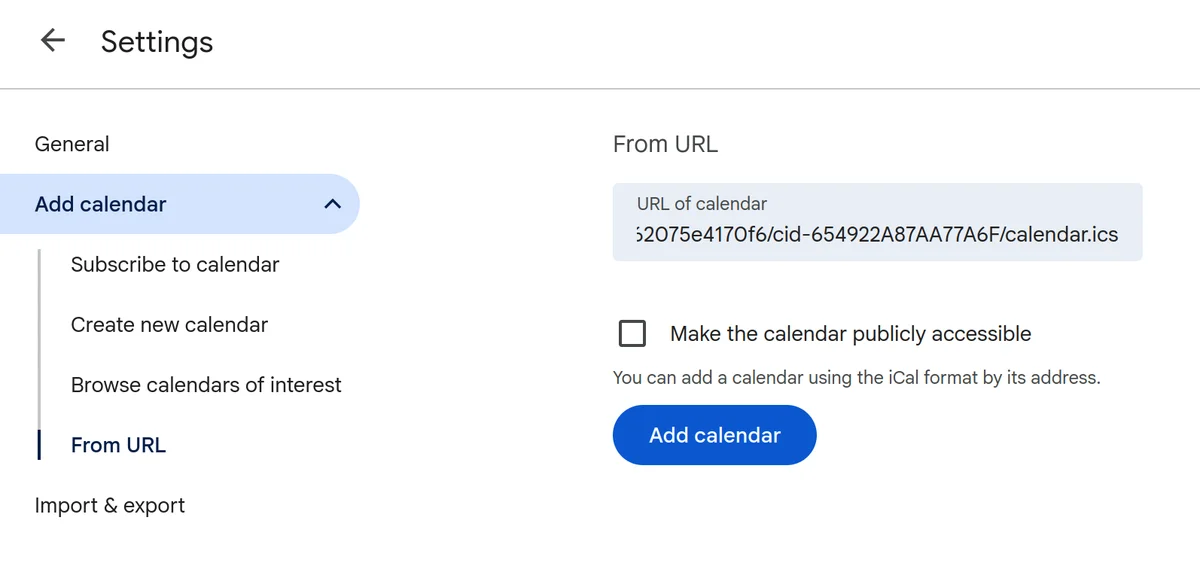
- Paste the ICS or webcal URL
- Click Add calendar
The calendar now appears in your sidebar. You’ll see all events from that calendar overlaid on your own.
Where to find ICS URLs from other services
From Outlook:
- Go to Settings > Calendar > Shared calendars
- Under Publish a calendar, select a calendar and choose Can view all details
- Copy the ICS link
From iCloud:
- In Calendar app, right-click a calendar and select Share Settings
- Enable Public Calendar
- Copy the link
From Airbnb:
- On your listing, find the Calendar section
- Copy the iCal link to share availability
Limitations of ICS subscriptions
- Read-only — you see events but can’t edit them from Google Calendar
- Slow refresh — updates appear 12–24 hours later, not in real time
- No privacy controls — all event details are visible or nothing is visible
- One-way only — events go from source to Google Calendar, not the reverse
- No duplicate detection — if the same event exists in both calendars, you’ll see it twice
This works well for viewing public calendars (holidays, sports schedules, availability), but it’s not suitable for keeping multiple personal calendars in sync.
Alternative: Use Hetk for real-time two-way sync
If you have events in multiple calendar providers and need them to stay in sync automatically, Hetk is a better solution than ICS subscriptions.
Hetk syncs events between Google Calendar, Outlook, and iCloud in real time using official APIs. Unlike ICS subscriptions, Hetk offers:
- Real-time sync — changes appear within 1–5 seconds, not hours or days
- Bi-directional — edit in either calendar and changes flow back to the source
- Privacy controls — choose to show full details, just “Busy”, or strip all content (title, description, attendees)
- Duplicate detection — Hetk won’t create duplicate events if the same meeting exists in both calendars
- Identity transform — synced events show your own email as organizer, not the source calendar’s email
- Automatic updates — no need to manually refresh or manage subscriptions
Example: Work and Personal Calendars
If your work calendar is in Outlook and your personal calendar is in Google Calendar:
- Hetk syncs them bidirectionally
- When someone schedules a work meeting in Outlook, it appears on your Google Calendar within seconds
- You’re immediately aware of the conflict if that time was already booked personally
- You can even edit the Google Calendar event and have the change flow back to Outlook
This prevents double-booking and keeps you aware of all your commitments across both calendars.
Example: Sports team schedule + Personal calendar
Want to keep your Google Calendar updated with your team’s game schedule?
With ICS subscription: Subscribe to the team’s ICS feed once. Games appear in your calendar and update every 12–24 hours. If the team reschedules a game, you might not find out for a day.
With Hetk: Hetk syncs the team’s calendar in real-time. If the team updates the schedule, it appears on your Google Calendar within seconds.
When to use Hetk vs ICS subscriptions
Use ICS subscriptions for:
- Public calendars that rarely change (holiday schedules, conference dates)
- One-time viewing of someone’s availability
- Sources where you don’t need real-time updates
- Free calendars with no need for privacy controls
Use Hetk for:
- Syncing between multiple personal or work calendars
- Situations requiring privacy controls (hiding details)
- When you need real-time updates (sports games, schedule changes)
- Preventing double-bookings across multiple calendars
Pricing
Hetk’s Personal plan covers up to 3 calendars for $15/year, or $10/year with early adopter pricing. This includes a 21-day free trial. If you use multiple calendar providers daily, Hetk pays for itself by preventing scheduling conflicts and saving time.
Troubleshooting ICS subscriptions
Calendar subscription doesn’t appear
Problem: You’ve pasted an ICS URL into Google Calendar and clicked “Add calendar,” but the calendar doesn’t show up in your sidebar.
Causes and fixes:
- Invalid URL: The URL format is wrong. Check that it starts with
http://,https://, orwebcal://. Google Calendar web requireshttps://orwebcal://(not plainhttp://) - Calendar is private: The source calendar isn’t published or shared publicly. Ask the owner to publish the calendar or share it with “Anyone can view”
- Server is down: The source calendar’s server is temporarily unavailable. Wait a few minutes and try again
- Network issue: Your internet connection is unstable. Refresh the page (Ctrl+R or Cmd+R) and try again
Subscription URL is broken
Problem: The subscription used to work, but events stopped appearing or you see an error message.
Causes:
- Source calendar was deleted or unpublished: The calendar owner deleted the shared calendar or turned off sharing. Contact them to republish it
- URL changed: Some calendar sources (like Airbnb) change their URLs when the listing is updated. Copy the new URL and replace the old one in Google Calendar
- Server changed location: The calendar provider moved servers. This is rare, but if it happens, you’ll need a new URL
Solution: Delete the broken subscription and re-add it with the current URL. Go to Settings > Calendars > [Calendar name] > Delete calendar.
Events show up late or not at all
Problem: You’ve subscribed to a calendar, but new events take days to appear, or they don’t appear at all.
Causes:
- Slow refresh rate: ICS subscriptions refresh every 12–24 hours. This is normal and can’t be changed. If you subscribed yesterday, wait 24 hours to see all events
- Manual sync failure: Sometimes Google Calendar stops syncing a subscription. Click the three-dot menu next to the calendar and select “Refresh” to manually force a sync
- Calendar is too large: If the source calendar has 10,000+ events, Google may slow down or skip updates to manage performance
- Subscription limit reached: Google Calendar can handle ~100 subscribed calendars, but after that, syncing may slow down
Solution: Refresh manually, wait 24 hours for the next automatic sync, or contact the calendar owner to verify the source calendar is still shared.
Frequently asked questions
Can I speed up ICS refresh?
No, the refresh rate is controlled by the calendar provider (Google, Outlook, iCloud), not by you. Most providers default to 12–24 hours. Some sources may update faster (6–12 hours) or slower (24–48 hours), but you can’t change this. If you need real-time updates, use Hetk instead.
Why are some events missing?
This could happen for a few reasons:
- Not yet synced: If you just subscribed, wait 12–24 hours for the first sync
- Too many events: The source calendar has so many events that Google skips some to manage performance
- Calendar is too large: If there are 10,000+ events, subscriptions may be incomplete
- Private events: The source calendar is shared with “View all events” but private events (marked as private by the owner) may not sync
Solution: Contact the calendar owner to verify the calendar is shared correctly, or switch to a sync tool like Hetk that handles large calendars better.
What’s the difference between ICS and CalDAV?
ICS (iCalendar) is a file format for events. You subscribe to an ICS URL and get a static snapshot that updates periodically.
CalDAV is a protocol that allows your calendar app to sync with a server in real-time. It’s bidirectional and more efficient than ICS subscriptions.
Most calendar apps support both. ICS subscriptions are simpler to set up (just a URL), while CalDAV syncing (used by Hetk and other tools) is faster and more reliable.
In practice: ICS subscriptions are good for public calendars, CalDAV/API-based sync (like Hetk) is better for personal calendars.
Which should you use?
| Scenario | Best option |
|---|---|
| View a published holiday or sports calendar | ICS subscription |
| Check Airbnb availability calendar | ICS subscription |
| Keep work and personal calendars in sync | Hetk |
| Sync Google, Outlook, and iCloud together | Hetk |
| One-time import of past events | ICS subscription or manual export |
| Real-time updates needed | Hetk |
For personal productivity and multi-provider sync, Hetk offers real-time updates and two-way sync that ICS subscriptions can’t match. Try the 21-day free trial to see the difference.
Related
- How to subscribe to ICS in Outlook
- How to sync Google Calendar with Outlook (real-time)
- Best calendar sync tools in 2026
Try Hetk free for 21 days — sync your calendars across Google, Outlook, and iCloud.
Start Free Trial